Do You Provide Junk Removal for Whole Buildings?
Whole-building junk removal in Dubai can be planned for approved units and common areas when ownership, scope, access, staging, and collection phases are clear.

Yes, whole-building junk removal in Dubai can be planned when an authorised owner or property manager defines the units and common areas, confirms the property is ready for clearance, and provides a workable lift, loading, and vehicle schedule. A large building may need phased collections rather than one continuous load.
Warehouse Junk Removal supports approved large commercial loads and planned operational access. Bulk Trash Pickup suits defined one-time loads from residences or commercial properties.
What counts as a whole-building clearance?
A whole-building clearance is a coordinated project covering multiple approved spaces under one authority. The scope might include vacant apartments, office suites, storage rooms, plant-free utility stores, reception furniture, or a designated common-area holding point.
The phrase does not give a removal crew authority over everything on the premises. Occupied units, tenant property, leased equipment, documents, fixed building systems, and disputed belongings must stay outside the collection unless the responsible party has resolved their status.
| Project zone | Possible approved contents | Scope control needed |
|---|---|---|
| Vacant units | Furniture, freestanding appliances, boxes, loose household items | Unit list and sign-off from the authorised contact |
| Offices or retail suites | Desks, chairs, shelving, displays, disconnected equipment | Asset-release list and business access window |
| Storage rooms | Cartons, loose stock, racks already released for removal | Clear keep/remove marking and room ownership |
| Shared holding area | Resident move-out furniture and bulky junk | Confirmation that management controls every item |
| External service area | Approved pallets, loose fixtures, outdoor furniture | Vehicle route, loading point, and material boundaries |
Who must approve the items before removal?
The party with authority over the building and its contents must approve the project. That may be an owner, authorised property manager, facilities lead, landlord, office administrator, or appointed representative.
The removal team should not infer abandonment from an unlocked unit, a label, or an item left in a corridor. The client should resolve tenant notices, ownership questions, inventories, and contractual requirements before collection without asking the crew to make legal or tenancy decisions.
Separate disputed and data-bearing property
Do not place uncertain belongings, tenancy files, keys, access cards, computers, drives, or financial records in a general building load. Keep them secured until an authorised person confirms their route.
How is a multi-unit project surveyed and quoted?
A usable survey records each approved area, the main item groups, access between floors, and the final loading route. Send a floor or unit list with wide photographs rather than one total such as “ten apartments.”
- Identify every unit, room, store, and common area in scope.
- Mark occupied, excluded, locked, or undecided spaces.
- Photograph representative contents and unusually heavy or fragile pieces.
- Record service-lift capacity, stairs, corridors, door widths, and loading-bay rules.
- Confirm where materials can be staged without blocking building operations.
- Choose the person who can approve a scope change during the work.
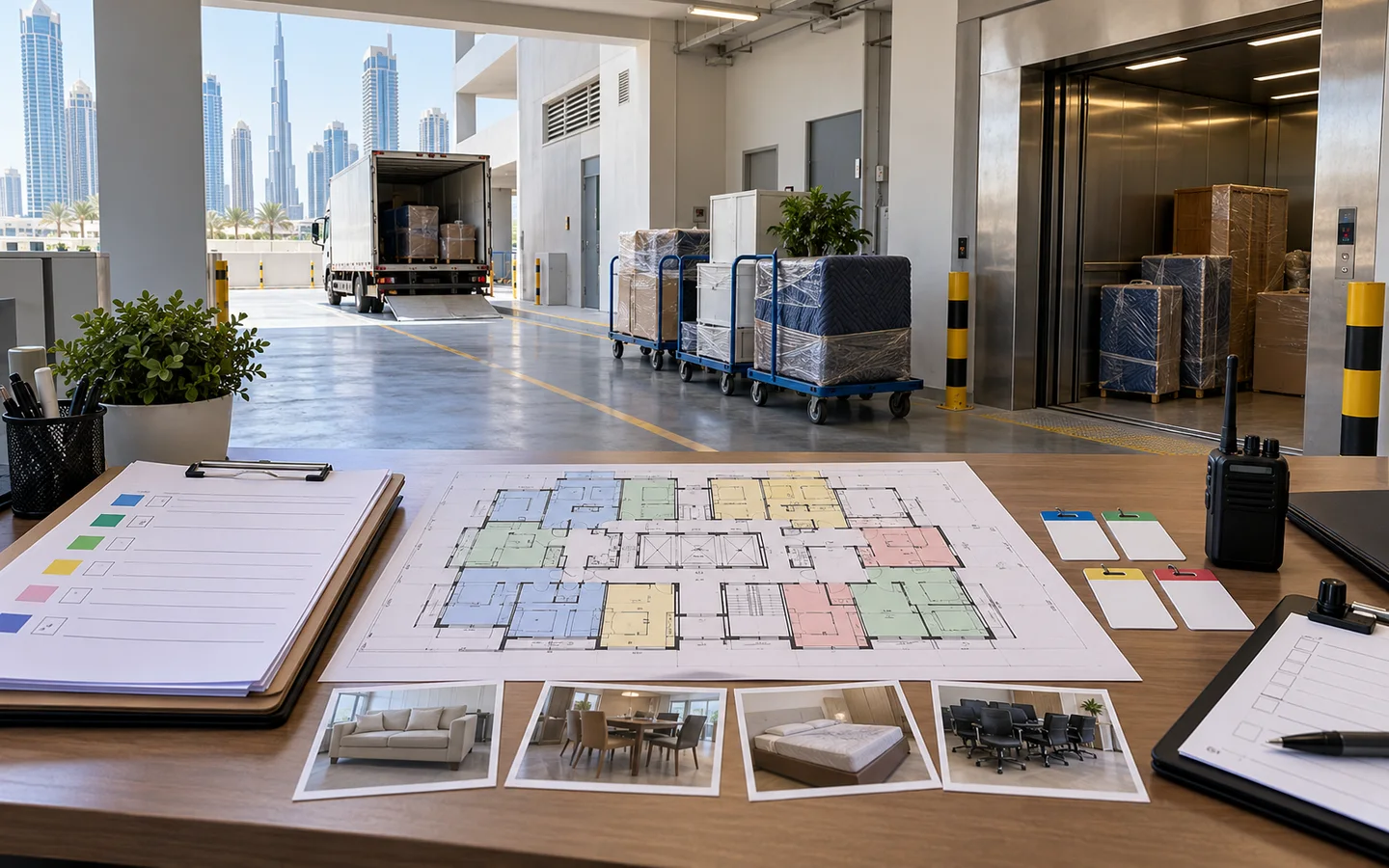
The guide to mixed-junk load pricing in Dubai explains why material categories and access matter more than a rough pile description. A building project adds another layer: the crew must know which unit owns each group and when that group can enter the shared route.
Why are whole-building clearances often phased?
Phasing keeps lifts, corridors, loading bays, and occupied parts of the property usable. One phase may cover the upper floors, another may cover vacant commercial areas, and a final phase may collect approved common-area material.
The practical phase boundary depends on volume, working windows, loading capacity, active occupants, and downstream material routes. Do not promise a one-day finish before the survey establishes those constraints.
Property managers handling recurring resident move-outs may need a standing collection process instead of a one-off building clearance. The property-manager bulk waste guide covers ongoing shared-area control, while this article covers a defined multi-unit project with a start and finish.
What remains outside ordinary building junk removal?
Structural demolition, wall removal, built-in system decommissioning, hazardous-material remediation, pest control, and post-project cleaning are separate trades. Gas-connected, hard-wired, plumbed, or fixed equipment should be isolated and released by an appropriate qualified contractor before it joins the removal scope.
Unknown chemicals, leaking containers, gas cylinders, medical waste, and other restricted material should not be hidden inside boxes or mixed loads. Photograph each questionable material and obtain an explicit handling decision.
How should the building prepare for the first collection phase?
Issue one current area list, mark exclusions, reserve the approved service route, protect resident access, and nominate a facilities contact for the full working window. Each unit or zone should receive a final check before its contents reach the shared staging point.
The before-arrival junk removal checklist works at room level. A whole-building plan repeats that control for every approved zone, then adds a master inventory and lift schedule.
To request a whole-building assessment, send the property type, number of approved units or zones, representative photos, access hours, loading details, and the authorised site contact by WhatsApp.
Frequently asked questions
Several approved units can form one project, but the schedule depends on item volume, lift and loading capacity, access windows, and the number of active occupants. Large scopes may be divided into controlled phases.
The building owner, authorised property manager, facilities team, or another party with documented control of the areas should approve the scope. A removal crew cannot decide that tenant or stored property is abandoned.
Furniture from several approved units can share a planned load when each unit's items are inventoried and compatible material groups remain identifiable. Personal records, electronics, and disputed property should stay separate.
Ordinary approved furniture, appliances, boxes, fixtures already detached by the right trade, and commercial junk may fit the scope. Demolition, structural strip-out, chemicals, and hazardous remediation require appropriate specialist contractors.
Related articles

How Much Junk Fits in One Pickup? Dubai Load Guide
Estimate whether your Dubai junk will fit in one pickup by grouping items, checking access and sharing honest photos before booking on 10/09/2026.

What Should I Do Before the Junk Removal Team Arrives?
Before a junk removal team arrives in Dubai, confirm the item list, isolate valuables, clear the carry route, prepare access, and nominate one decision-maker.

How Do You Access Villas and Gated Communities in Dubai?
Villa and gated-community junk removal in Dubai works when the resident confirms security entry, the vehicle route, parking, and the approved collection window.