Co-Working Space Clearance in Dubai
Plan a co-working space clearance in Dubai around member access, asset ownership, IT separation, service lifts, and a controlled final handover.

A co-working space clearance in Dubai works best when the operator freezes the final asset list, separates member property from operator-owned furniture, and confirms the building route before collection. The main challenge is not the number of chairs or cartons. It is clearing a shared workplace without mixing ownership, exposing devices, or blocking members who still use the site.
For desks, chairs, shelving, cartons, and other mixed commercial items, Warehouse Junk Removal supports the larger clearance load. Route monitors, printers, cables, and other approved devices through Electronics Disposal rather than placing them in ordinary office junk.
Start with ownership, not condition
An old chair can belong to the operator, the landlord, a serviced-office member, or a furniture supplier. Its condition does not establish permission to remove it. Appoint one person who can approve the final list and resolve questions during the job.
Use three clearly marked groups:
| Group | Typical contents | Required decision |
|---|---|---|
| Keep in place | Active desks, meeting-room furniture, shared equipment | Protect and exclude from the removal route |
| Transfer | Furniture or equipment moving to another branch | Label destination and keep separate from junk |
| Remove | Approved unwanted furniture, empty shelving, ordinary cartons | Confirm quantity, access needs, and collection route |
| Restricted review | Devices, records, access hardware, unknown property | Hold for an authorized internal decision |
The office junk removal guide covers a conventional single-tenant workplace. A co-working site needs an extra ownership layer because several members may occupy one floor and use the same meeting rooms, lockers, and circulation space.
Map the clearance around active member zones
If part of the site remains open, do not move unwanted furniture through occupied hot-desk areas whenever another route is available. Divide the floor by room or zone, publish the collection window internally, and keep reception informed about contractor access.
Confirm:
- which rooms close for the collection;
- which desks and meeting rooms remain bookable;
- where the crew enters and signs in;
- which lift carries bulky furniture;
- where the vehicle may load; and
- who can make an immediate ownership decision.
Use one clearance controller
Give one facilities or operations representative the approved list and authority to answer the crew. Conflicting instructions from reception, members, and contractors create avoidable stops and increase the risk of moving the wrong asset.
Separate IT equipment and member data before collection
Do not leave computers, drives, routers, access-control devices, payment terminals, or paper records inside a general remove zone. Disconnecting a device does not remove its data or cancel the accounts attached to it.
The operator should complete its own asset and data process before a device is released. Record serial numbers where the business requires an audit trail, remove personal or company accounts, and keep access cards and keys under direct control. Empty lockers only after the operator has followed its member-notification and property procedure.
The office furniture disposal guide focuses on desks, seating, and larger corporate furniture systems. Use that process for a furniture-heavy floor, while keeping data-bearing items in a separate controlled stream.
Stage the floor without blocking the escape route
Create remove zones inside closed rooms or other approved private areas. Shared corridors, lift lobbies, stair doors, reception paths, and fire equipment must remain accessible.
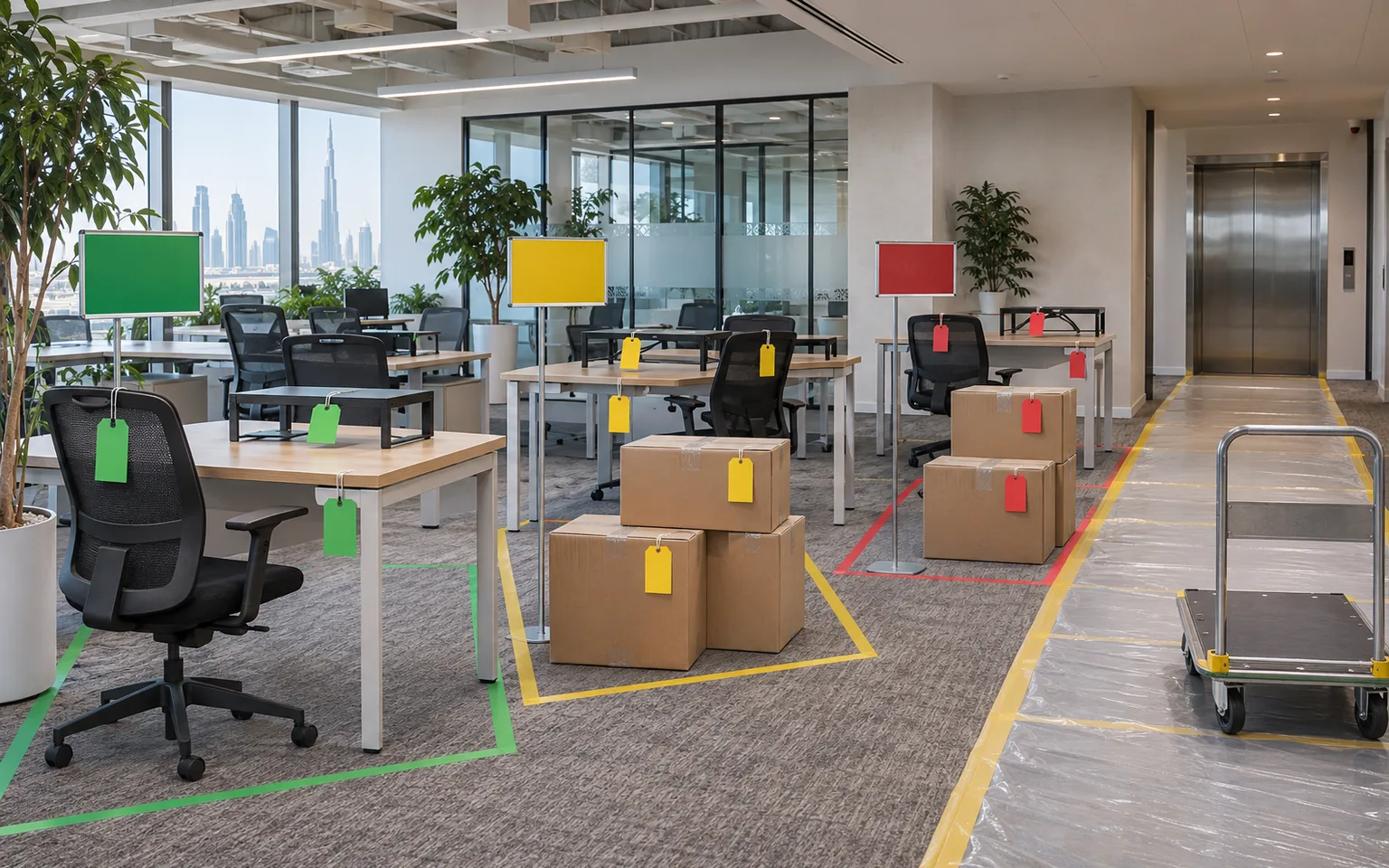
Photograph each completed zone before collection. The images give the operator and removal team the same visual record and reveal additions that were not included in the first load estimate.
Freestanding desks and tables may be separated into manageable transport sections when practical. Cutting fitted joinery, removing fixed glass partitions, disconnecting hard-wired equipment, taking down signage, and carrying out reinstatement repairs need the relevant specialist and should not be treated as standard junk removal.
What should the building access brief include?
Send the exact property, floor, contractor entrance, service-lift booking, loading point, approved hours, and on-site contact. Include door or lift measurements when an item is unusually long or wide.
For a phased closure, plan collections by zone instead of building one mixed pile. A sensible order is surplus store-room stock first, unused offices second, shared areas after member access ends, and reception furniture only when the customer-facing operation has closed.
Book the final co-working clearance
Send the approved asset list, clear photos, device count, building instructions, and preferred collection window on WhatsApp or through the contact page. Keep member property and transferred assets outside the remove zones until the final walkthrough is complete.
Frequently asked questions
Yes, when the operator divides the site into active and clearance zones, protects the shared route, and assigns collection windows outside busy member periods. The final plan still depends on the building's approved access hours and lift availability.
The operator should appoint one authorized decision-maker and verify ownership against the asset list, landlord inventory, and any furniture supplied by members or vendors. A removal crew should not decide ownership from an item's location or condition.
Computers and data-bearing devices should be separated from ordinary furniture before collection. The operator remains responsible for access control, account removal, data handling, and choosing an appropriate electronics route for each device.
Send wide photos of every clearance zone, counts of desks and chairs, close views of bulky items, the service-lift route, and the loading point. Mark retained assets clearly so the quoted load matches the items authorized to leave.
Related articles

Furniture Showroom Clearance in Dubai
Clear a Dubai furniture showroom with a final stock split, measured loading route, protected display items, staged back-room stock, and one handover plan.

Staff Accommodation Furniture Clearance in Dubai
Plan a Dubai staff accommodation clearance room by room, separating personal property, mattresses, bed frames, shared furniture, access, and final approval.
Cafe & Coffee Shop Clearance in Dubai
Plan cafe clearance in Dubai with an ownership inventory, separate appliance preparation and a confirmed loading route for unwanted furniture and equipment.