Business Waste Audit Checklist for Dubai Offices
Use this Dubai office waste audit checklist to map material streams, find avoidable waste and plan safer, more efficient commercial clear-outs.

How do you audit waste in a Dubai office?
A Dubai office waste audit should map where materials arise, separate them into useful categories, measure a representative period and turn the findings into assigned actions. The audit is not a search through employees' personal rubbish. It is an operational review of purchasing, storage, reuse and removal.
Use the checklist below before changing bins or booking a clear-out. If the audit identifies mixed commercial material ready to leave, our Waste Removal Dubai service can quote the approved general load from photos and access details.
Before the audit: define a safe scope
- Name one person responsible for the audit record.
- List every included zone, from reception to the back store.
- Choose a normal working period rather than an event or moving week.
- Tell cleaning, facilities, IT and procurement teams what will be observed.
- Exclude confidential records from manual inspection.
- Exclude batteries, chemicals, medical material and other restricted waste from general sorting.
- Prepare plain containers or floor areas for clean, non-hazardous material groups.
- Decide how quantities will be recorded, such as bag count, box count or container fill level.
Keep restricted streams separate
A general office waste audit should not expose confidential documents or ask staff to handle unknown chemicals, leaking batteries, medical waste or sharp objects. Record the presence of a restricted stream and refer it to the organization's approved specialist process.
Which office zones should be checked?
Every zone creates a different pattern. Combining the whole office into one total hides the source of avoidable waste.
| Office zone | Common material to record | Useful audit question |
|---|---|---|
| Workstations | Paper, stationery, small packaging | Are supplies over-ordered or duplicated? |
| Print point | Misprints, toner packaging, retired devices | Can settings or approvals reduce repeat printing? |
| Pantry | Food packaging, cups, cartons | Are containers clearly placed for the actual materials used? |
| Meeting rooms | Bottles, catering packaging, flip-chart paper | Does event ordering match attendance? |
| IT area | Cables, keyboards, screens, small devices | Is there an asset and data-clearance process? |
| Store room | Cartons, surplus furniture, old promotional material | What has no owner, use date or approved route? |
| Loading area | Pallets, transit wrap, damaged stock | Can suppliers take back or reduce packaging? |
Large stock rooms or palletized loads may need a separate Warehouse Junk Removal assessment because access, equipment and load composition differ from a desk-based office clear-out.
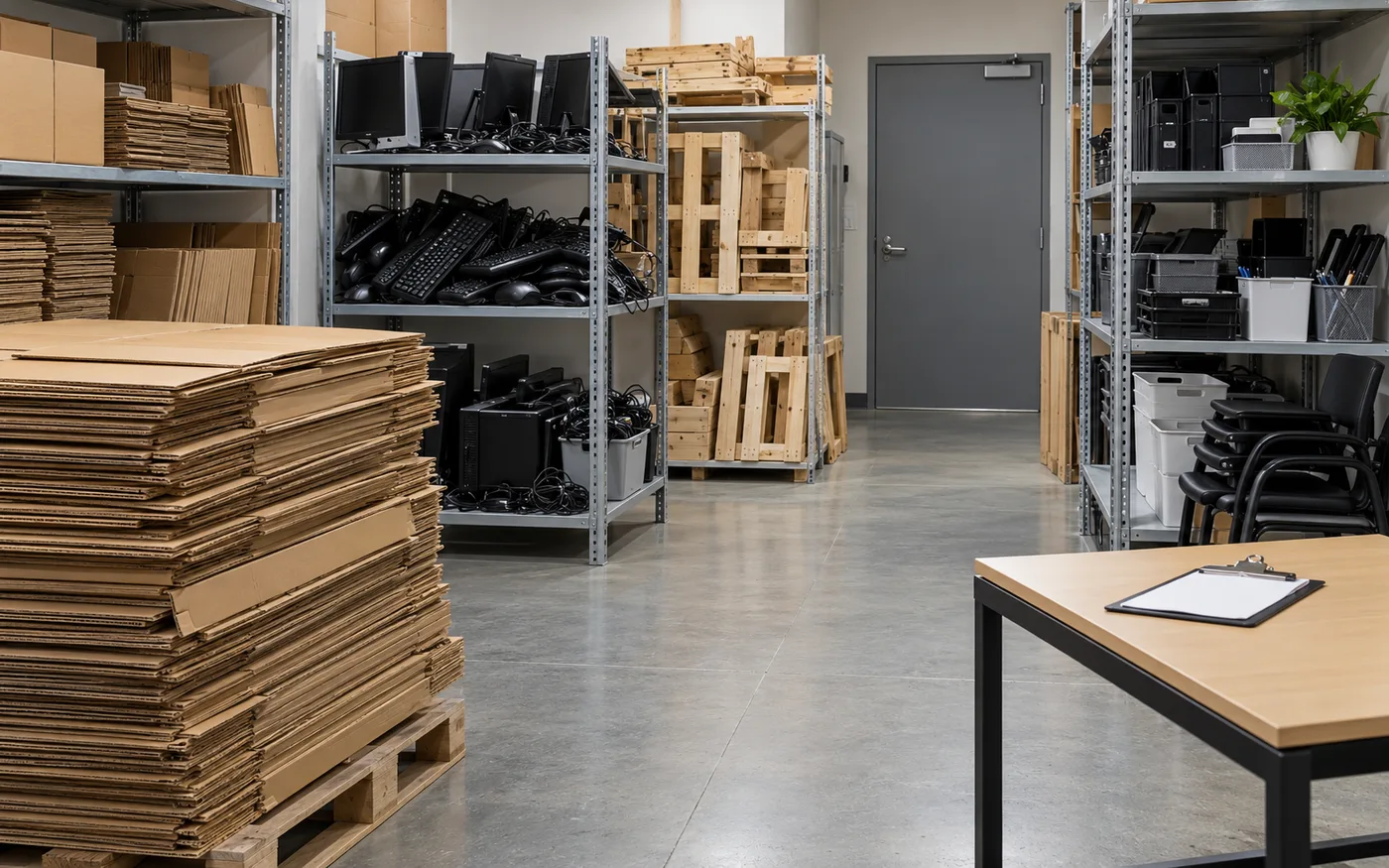
During the audit: record material, source and condition
Use one line per material group. A useful record contains:
- Source zone: where the material entered the waste stream.
- Material type: cardboard, paper, metal, plastic, furniture, electronics or mixed residual waste.
- Condition: clean, reusable, damaged, contaminated or incomplete.
- Quantity: use a consistent unit that the team can repeat.
- Current route: internal reuse, supplier return, specialist collection or general disposal.
- Cause: routine consumption, damage, over-ordering, expired storage or a one-off project.
- Owner: the department able to change the process.
Photos can document bulky items and storage layouts, but photographs should not capture employee details, confidential screens, labels or private paperwork.
How should the findings become an action plan?
An audit is useful only when each finding receives an owner and next step. Sort actions by prevention first, then reuse, separation and collection.
Prevent unnecessary material entering the office
Procurement can compare actual use with order frequency, consolidate deliveries and challenge automatic reordering. Facilities teams can remove abandoned supply points that attract duplicates.
Reuse items inside the business
Create a visible internal pool for serviceable chairs, monitor arms, stationery and storage boxes. Record ownership so reusable items do not become anonymous store-room clutter.
Separate clean material at the point of use
Place containers where a material arises, not where there happens to be spare floor space. Instructions should match the routes that are genuinely available to the business. A container labelled for a stream that later gets mixed undermines staff confidence.
Schedule bulky clear-outs around operations
Group approved furniture, shelving and equipment by zone. Confirm goods-lift access, loading arrangements and working-hour restrictions with building management before collection. Our office move checklist covers the wider coordination needed during a relocation.
Office waste audit action register
| Finding | Immediate action | Longer-term control | Owner |
|---|---|---|---|
| Repeated unopened stationery | Pause reorder and count stock | Set minimum and maximum levels | Procurement |
| Flat-packed cartons blocking store access | Flatten and group clean card | Agree a delivery-unpacking routine | Facilities |
| Retired peripherals without inventory | Create a separate secure holding area | Add IT retirement sign-off | IT |
| Broken chairs mixed with usable furniture | Mark and separate by condition | Maintain a furniture register | Facilities |
| Event packaging spikes | Match orders to confirmed attendance | Review supplier packaging options | Office management |
What should never go into the general removal group?
Keep these items outside the ordinary office junk load until the correct route is confirmed:
- confidential paper and storage media awaiting secure handling;
- devices that have not passed the organization's data-removal process;
- loose or damaged batteries;
- chemicals, solvents and unknown liquids;
- medical or clinical waste;
- fire extinguishers, gas cylinders and pressurized containers;
- building fixtures that require a qualified contractor to disconnect.
For electronic equipment after internal approval, review our guide to commercial electronics disposal in Dubai. An audit does not certify data destruction or regulatory compliance; it supplies the inventory needed for the company's authorized process.
When should the audit be repeated?
Repeat the same method after a meaningful operational change, such as a fit-out, supplier change, occupancy shift or new pantry arrangement. Use the same zones and quantity units so the second record is comparable with the first.
Before requesting collection, photograph only the approved outgoing groups and provide loading access, item count and dismantling details. That keeps the quote tied to the audited load rather than an uncertain estimate.
Frequently asked questions
A practical office waste audit records where discarded materials arise, what they contain, how often they accumulate and which route they currently follow. The result should identify specific changes in purchasing, storage, reuse and collection.
Choose a representative working period that includes normal deliveries, pantry use and routine operations. Avoid basing decisions on a single unusual event, office move or low-occupancy day.
No. Keep confidential material within the company’s approved secure-handling process. Record its container volume or collection frequency without exposing, photographing or mixing sensitive documents.
Retired computers, screens, printers and peripherals should be inventoried separately from general waste. Remove business data through the organization’s approved IT process before arranging an appropriate electronics route.
Include workstations, print points, meeting rooms, pantry areas, reception storage, IT rooms and any back-of-house store or loading area. Different zones usually produce different materials and need different controls.
Provide photos, approximate quantities, item types, access conditions, parking or loading instructions, preferred timing and any dismantling needs. Keep confidential records and restricted materials out of the quoted general load.
Related articles

Office Move Junk Removal Checklist for Dubai
Step-by-step checklist for office junk removal in Dubai: building work permits, service lift bookings, redundant IT disposal, and office furniture clearance.

Appliance Disposal Checklist Before You Upgrade
Replacing a fridge or washing machine in Dubai? Check ownership, delivery timing, safe disconnection and the old appliance's removal route before upgrade day.
End-of-Lease Checklist: Avoid Deposit Deductions in Dubai
Use this Dubai end-of-lease checklist to document the property's condition, clear your belongings, confirm handover details and review any deposit deduction.